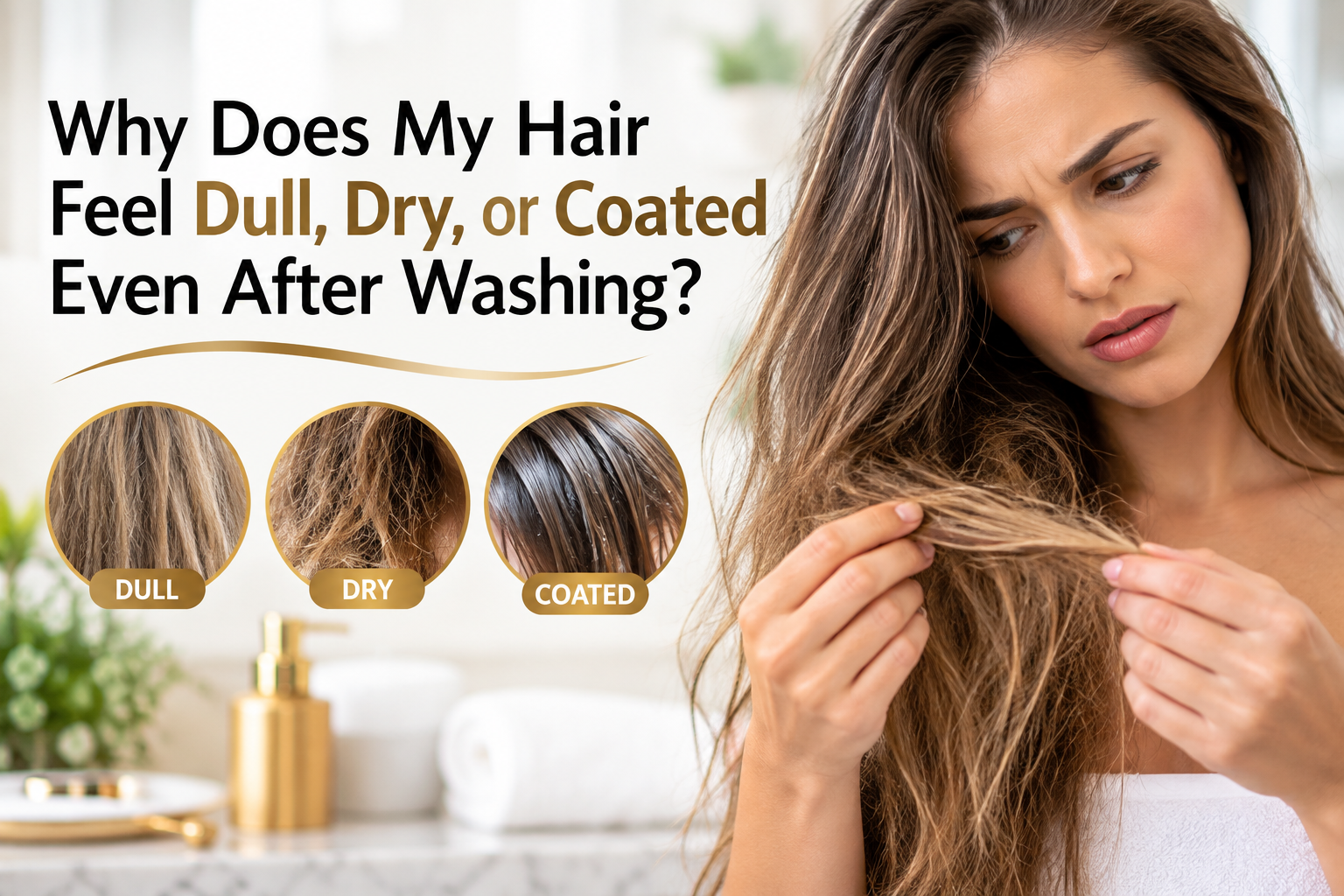
Why Does My Hair Feel Dull, Dry, or
Coated Even After Washing?
You shampoo your hair, rinse thoroughly, and expect it to feel clean, soft, and refreshed. Instead, it may still feel dull, dry, rough, heavy, waxy, or coated. It is easy to assume that your shampoo isn't cleaning well enough—or that your hair simply needs more conditioner.
But those aren't the only possibilities. The way your hair feels after washing can be influenced by product accumulation, natural oils, water quality, chlorine exposure, cleansing and conditioning habits, chemical processing, hair porosity, or a combination of factors.
Understanding the likely cause is the first step toward choosing the right solution.
Quick Answer
Hair can still feel dull, dry, rough, or coated after washing because the problem may not be ordinary dirt or oil. Product residue, hard-water minerals, chlorine exposure, cleansing or conditioning habits, and increased porosity from chemical processing can produce similar symptoms.
Because these conditions may require different approaches, identifying what is affecting your hair is usually more useful than automatically shampooing again or applying more conditioner.
Why Can Clean Hair Still Feel Dirty or Coated?
Shampooing removes oils and soils from the hair and scalp, but your hair is exposed to much more than ordinary dirt.
Conditioners, styling products, leave-in treatments, minerals from water, swimming-pool chemicals, and repeated chemical services can all influence the way the hair surface feels and behaves.
That's why “my hair doesn't feel clean” doesn't necessarily mean you simply need to wash it more often. The better question is:
What might be causing my hair to feel this way?
Can Product Buildup Make Hair Feel Coated?
Many hair products are designed to leave useful materials behind.
Conditioning agents, styling polymers, oils, silicones, creams, sprays, and other ingredients may improve slip, shine, control, or manageability. Depending on your hair, the products you use, how much you apply, and how you cleanse, accumulation can sometimes become noticeable.
Hair may begin to feel:
- Heavy or coated
- Flat or difficult to style
- Waxy
- Less responsive to normal shampooing
- Dull despite using shine-enhancing products
Could Your Shampooing or Conditioning Routine Be the Problem?
Sometimes the issue isn't the shampoo itself but how products are being used.
For example, applying large amounts of conditioner or leave-in products to hair that becomes weighed down easily may contribute to a heavy feeling.
Incomplete rinsing can also leave hair feeling different from what you expect.
On the other hand, repeatedly using stronger cleansing in an attempt to fix rough or dry hair can create another problem if accumulation wasn't the primary cause.
Before changing products, consider your entire routine:
What are you applying? How much? Where are you applying it? How thoroughly are you rinsing? And what changed before the problem began?
Water quality deserves more attention than it usually receives. Hard water contains dissolved minerals, particularly calcium and magnesium. Research has demonstrated that hair can take up these minerals from water and that the condition of the hair can influence that interaction. Studies examining hard-water exposure have also found mineral deposition on hair fibers.
However, claims about hard water should not be exaggerated. Research examining its effects on hair strength and structure has produced differing results. One study found no significant difference in tensile strength or elasticity, while other research has reported changes in hair strength or physical properties.
The practical takeaway is simpler:
Water-related mineral accumulation is a legitimate consideration when hair begins behaving differently, but “hard water” shouldn't automatically be blamed for every case of dry or damaged hair.
It may be especially worth considering if your hair changed after moving, traveling, or experiencing a change in your water supply.
Can Chlorine Make Hair Feel Dry After Swimming?
Frequent swimming creates another type of exposure.
The American Academy of Dermatology notes that chlorine can affect protective hair lipids and contribute to hair becoming more susceptible to dryness, brittleness, frizz, reduced luster, split ends, and breakage.
A swimmer experiencing dull, rough hair may need a different approach than someone whose hair feels coated because of styling-product accumulation.
Could Your Hair Actually Be Dry or Damaged?
This is an important distinction.
Hair that feels rough isn't necessarily coated. Repeated highlighting, bleaching, permanent waving, straightening, heat styling, environmental exposure, and mechanical wear can change the physical condition of the hair fiber.
In that situation, repeatedly trying to “clean away” the rough feeling may miss the actual problem.
Look beyond the sensation of dryness and consider whether you're also noticing: tangling, increased breakage, loss of elasticity, rough ends, or a noticeable change following chemical processing.
Those clues can point toward a condition-of-the-hair issue rather than simply removable accumulation.
How Does Hair Porosity Affect Dry or Chemically Processed Hair?
Hair porosity is another reason that two people with “dry-feeling hair” may need completely different approaches.
Hair isn't an impermeable surface. Its cuticle and internal structure influence how it interacts with water and cosmetic treatments.
Chemical processing can alter that structure. Research on oxidative bleaching has documented changes to the cuticle and cortex, increased pore formation, protein loss with increasing bleaching severity, and other structural changes. PubMed
PubMed Permanent waving and bleaching can also affect the cuticle in different ways. Research has found that both types of treatment can make cuticle layers more prone to separation or damage.
This is why repeatedly highlighted, bleached, permed, or otherwise chemically processed hair may feel rougher, more porous, more fragile, or more difficult to manage.
And here's the important part: Porous or chemically damaged hair can also have buildup.
These conditions aren't mutually exclusive.
Someone can have increased porosity from chemical processing while simultaneously having styling residue or water-related mineral accumulation.
Buildup vs. Dryness: How Can You Tell the Difference?
There isn't one foolproof at-home test, but patterns can give you useful clues.
| If your hair feels… | Consider investigating… | Think about… |
| Heavy, flat, or coated | Product accumulation | Styling products,
leave-ins, conditioners |
| Waxy or greasy
after washing |
Cleansing/rinsing routine | Shampoo application,
oil and product use |
| Different after
moving or traveling |
Water quality | Mineral exposure |
| Dry or rough after
swimming |
Pool exposure | Chlorine plus cleansing
and conditioning |
| Rough, tangled,
or fragile after highlighting |
Porosity or chemical damage | Processing history and
hair condition |
| Coated and damaged | Multiple causes | Buildup and porosity
can coexist |
This distinction matters because the appropriate response to buildup may be very different from the response to chemically compromised hair.
Should You Shampoo More Often?
Not necessarily.
Instead, ask:
What am I actually trying to remove?
Ordinary oil and soil, styling-product accumulation, chlorine exposure, and water-related minerals aren't necessarily the same cleansing problem.
Likewise, if the real problem is increased porosity or chemical damage, simply increasing shampoo frequency may not address what you're feeling.
This is where choosing products by purpose becomes more useful than choosing them simply because they promise “clean hair.”
When Should You Use a Clarifying or Purifying Shampoo?
A clarifying or purifying shampoo can make sense when there is a reasonable reason to suspect removable accumulation.
That might include repeated use of styling products, swimming, or certain water-related deposits.
But don't assume every clarifying shampoo is designed for exactly the same purpose.
When evaluating one, consider:
What is it formulated to remove?
How frequently is it intended to be used?
What is the condition of your hair?
Is your hair color-treated or chemically processed?
What does the complete formulation—and not merely one highlighted ingredient—suggest about its intended use?
This last point is important. Shampoo performance depends on the complete formulation, including its cleansing system, conditioning components, ingredient concentrations, pH, and how the product is used and rinsed. An ingredient list alone cannot tell you exactly how a shampoo will perform on your individual hair.
Can You Clarify Color-Treated Hair?
Color-treated hair deserves additional consideration.
It's too simplistic to say either that every clarifying shampoo will “strip your color” or that every product marketed for color-treated hair will have no effect on color.
Hair condition, the coloring process, cleansing formulation, washing frequency, water temperature, and other factors can influence color maintenance.
If your hair is both color-treated and experiencing suspected buildup, the objective isn't necessarily to avoid clarification altogether.
It's to choose an appropriate cleansing strategy without ignoring the condition and history of the hair.
What Should You Do After Clarifying Your Hair?
Once removable accumulation has been addressed, pay attention to what your hair tells you.
Hair that feels lighter and more manageable afterward may support the idea that accumulation was contributing to the problem.
Hair that remains rough, fragile, tangled, or excessively dry may need you to look more closely at its condition, chemical history, and conditioning needs.
This is another reason not to treat clarification as the universal answer to dull or dry-feeling hair.
When a Purifying Shampoo May Be Worth Considering
If your hair tends to feel dull, coated, or difficult to manage and your history suggests swimming, chlorine exposure, hard-water exposure, or water-related accumulation, a specialized purifying shampoo may be worth considering.
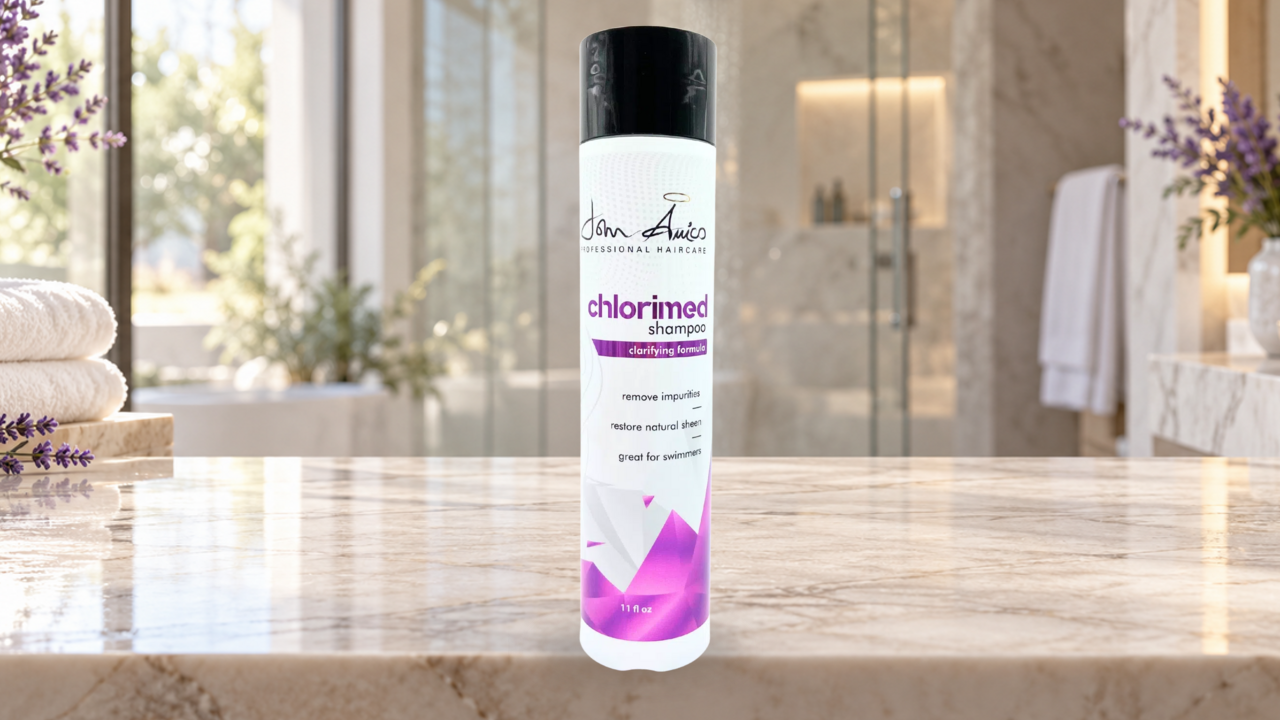
One option is John Amico Chlorimed Purifying Shampoo.
John Amico describes Chlorimed as a delicate purifying shampoo designed to remove various impurities, including chlorine and certain water-related minerals and chemicals. The supplied ingredient list includes a cleansing system along with sodium thiosulfate, citric acid, and tetrasodium EDTA. Manufacturer directions call for applying it to wet hair, lathering and cleansing thoroughly, then rinsing with warm water; the directions say the process may be repeated for excessively oily hair.
Affiliate disclosure: This article may contain affiliate links. If you purchase through one of these links, I may earn a commission at no additional cost to you.
Frequently Asked Questions
Why does my hair feel waxy even after shampooing?
A waxy feeling can have several possible causes, including styling or conditioning residue, excess oil, incomplete cleansing or rinsing, and water-related deposits. Consider what products, water exposures, or routine changes occurred before the problem appeared.
How do I know if my hair has buildup or is simply dry?
Hair that feels heavy, flat, waxy, or coated may suggest accumulation, while persistent roughness, tangling, fragility, or breakage—particularly following chemical processing—may point more toward dryness or structural damage. Both can occur simultaneously.
Can hard water make hair feel coated?
Hard water can contribute to mineral deposition on hair. Research has demonstrated uptake and deposition of calcium and magnesium under various conditions, although evidence about exactly how those deposits affect hair strength and damage isn't uniform. PubMed
Can highlighted or bleached hair feel dry because of increased porosity?
Chemical processing such as oxidative bleaching can alter the hair's cuticle and internal structure and increase porosity. That can contribute to changes in the way hair feels and behaves. PubMed
Can chemically processed hair also have buildup?
Yes. Chemical damage or increased porosity and external accumulation are different issues, but they can occur at the same time. Research also indicates that chemically damaged hair can interact differently with water-hardness metals. PubMed
The Bottom Line
If your hair still feels dull, dry, rough, waxy, or coated after washing, don't immediately assume you need stronger shampoo—or more conditioner.
Start by considering what changed and what your hair has been exposed to.
Product accumulation, cleansing and conditioning habits, hard-water minerals, chlorine, chemical processing, and increased porosity can produce symptoms that overlap.
Once you identify the most likely cause, you can choose a solution that addresses that particular problem rather than repeatedly treating the symptom.
And sometimes, the most useful next step isn't another product.
It's simply understanding your hair better.